The BalanceTime approach to health and happiness
How 8 ways, in 8 minutes or 8 days can turn the switch on health and happiness
Balance is one of my favourite ways to remember to focus on wellness.
This October
#WorldMentalHealthDay gives a reminder of lived experience of mental health challenges and as such I'd like to share how the words Balance Time offer a great hack for health and happiness in just eight small steps.
Steps that could be taken once a day - or one step over eight days, split over a day - to offer one step an hour or condensed into a 8-minute practice.
Take 8 minutes to explore one step to balance, every minute, now.
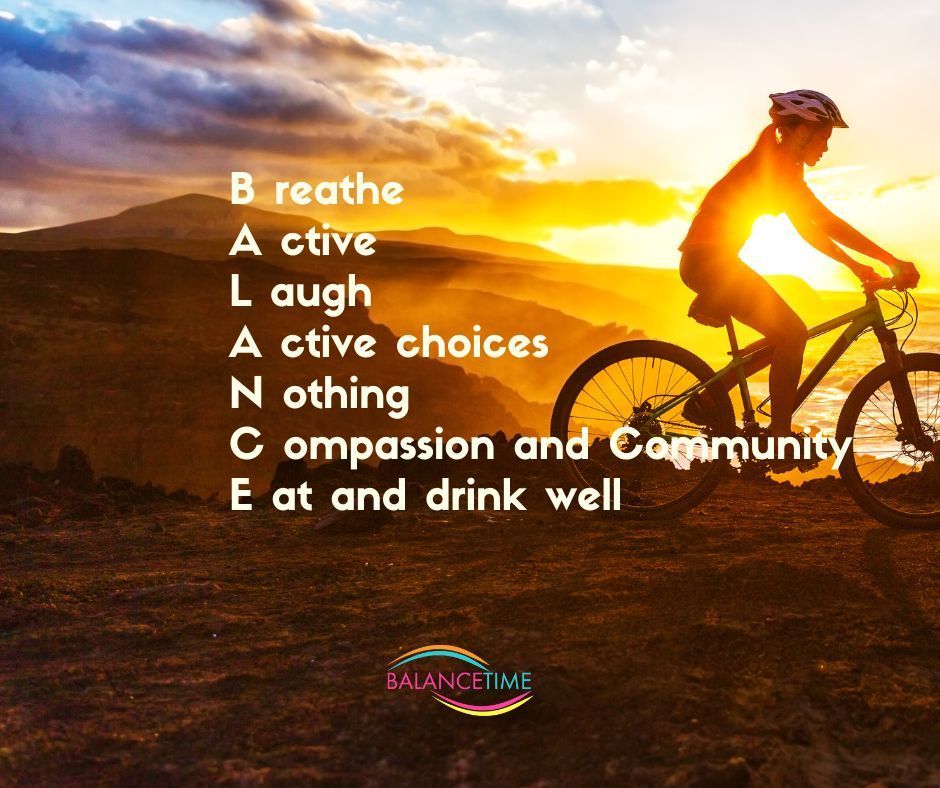
B reathe. Notice your breath or count it.
A ctive. Move. Stand. Stretch. Walk.
L augh. Try saying 'ha ha ha' like a cartoon villain
A ctively. Make a date for something that is good for your wellbeing.
N othing. Take a minute of absolutely nothing.
C ommunity Connection Compassion. How can you improve connection to someone through one kind act?
E at and drink well. Go on grab a glass of water and sip it gently.
TIME - reflect on giving yourself this time to pause, to move, and to notice - taking an extra minute of quiet thought - or even journaling - notice what comes up for you.
Take 80 minutes to find balance - you could enjoy one step an hour over or your day or spread this out with one action a day, over a week.
B reathe. Count how many breaths you take in a minute. Then once you have noticed, see if you can steady your breath to a count of just five breaths in a minute (to trigger your parasympathetic nervous system into a state of rest and digest). To do this, count your inhalation in for 5 (mentally noticing 1,2,3,4,5 before you exhale) and exhale for five (mentally noticing 1,2,3,4,5 before your inhale). Repeat 3 times and then see if you can increase your count to six for the last two breath-cycles. Try to keep breathing and avoid holding your breath. Invite your posture to straighten up, and allow your breath to flow deeply into your diaphragm, moving your belly, rather than shallow breathing into your chest. Once you have settled into this rhythm - either return to your day and let your breathing relax into a steady rhythmn - or if you can see if you can repeat this steady breath count for five minutes to allow your body to experience a relaxation response in your brain and body as stress hormones are broken down by this action.
A ctive. Can you meet your 10,000 (15,000/20,000) steps challenge? Can you move in between tasks? Can you move every 20 minutes, even if just a straightening of the spine, a stretch of the arms or legs. Can you arrange a walking meeting or phone call? What activity do you love and how can you bring this back to your day? Movement and exercise has a direct link not only to physical health improvements but also to fight depression and anxiety.
L augh. Can you bring more laughter to your day? You can try smiling and laughing even if you don't feel like it. Observe the feeling of a smile, physically on your face and how this makes your body feel. Observe a fake laugh, the breaths you take and the movement in your body. How can a more playful approach help you with problem solving or anxiety at home? Can you invite friends and family to plan some playful activities that support you, relax you and make you laugh and smile?
A ctively. Do you actively make time for your wellbeing? Get out your diary and plan a wellbeing date for you - time for you for that round of golf, that coffee with a friend, that night out with a loved one, a relaxing uninterrupted bath, that online class that caught your eye, that yoga class, that meditation experience. Look at the habits and regular activities in your schedule and see how you can make small changes to actively bring more good things for your health and happiness into your week. That might mean less box sets and more boxing, or switching off the device or TV and choosing time reading a book, chatting to a friend instead. Good active wellbeing habits positively impact physical and mental health.
N othing. When is the last time you did nothing? Can you switch off your device and just daydream looking out the window for 5 minutes? Can you bring your bedtime forward by 5 or 10 minutes to invite more sleep into your schedule? Can you have a social media/news detox for an hour/ a day? Do you have phone free time in meetings and with family? Do you ever have an office day with no meetings? Can you just take 10 minutes to just sit quietly with no agenda and no device? Pausing is one of the most underestimated tools for wellness. Creativity strikes when we pause and daydream. Sometimes the team will resolve the problem themselves if the manager pauses before rushing in to help. One in three people don't get enough sleep because they find it so hard to switch off. Can you start to change your routine to include space for quiet?
Community Connection Compassion Kindness is good for you - helping others and boosting our happiness levels at the same time. Can you think kindly, speak kindly and act kindly - just for today? If you feel disconnected from someone or in conflict - see how kindness can help - from a kind word, to a positive thought about them, to not reacting when they say something callous. Are you connected? Who supports you - is it time to fix a call with them? Are others relying on you - do you need to make time for them? How about your community - at work, at home and in the place where you live, what compassionate act can help you feel more connected? From donating to the food bank, picking up litter around where you live, to bigger charity projects and commitments. And remember, support goes both ways - is it time for you to reach out and ask for a helping hand for you?
Eat and drink well. Dehydration is the main cause of workplace tiredness. Can you have a drink of water and cut back on the caffeine and sugary drinks. A balanced nutritional diet will give you more energy. Are you getting your '5 a day' (fruit and vegetable portions). Do you start breakfast with one (or more) of your five a day. Can you go European and increase this to 7 a day, or as one nutritionist once suggested - aiming for 30 tastes of fruit, vegetables and fresh herbs and spices (here a clove of garlic, or sprinkle of chilli flakes all count as one of your 30. This high number reminds us to add flavour, variety and colour to our plates which can help with a good balance of vitamins, minerals and nutrients.
TIME. If you have just taken this time for you - even just reading this blog - congratulations. We get so busy we forget what it means to take time, whether it's a reminder to move or simply to notice your breath i this moment.
May taking TIME to find BALANCE help you look after your health and happiness and take (8) steps to your wellbeing.